
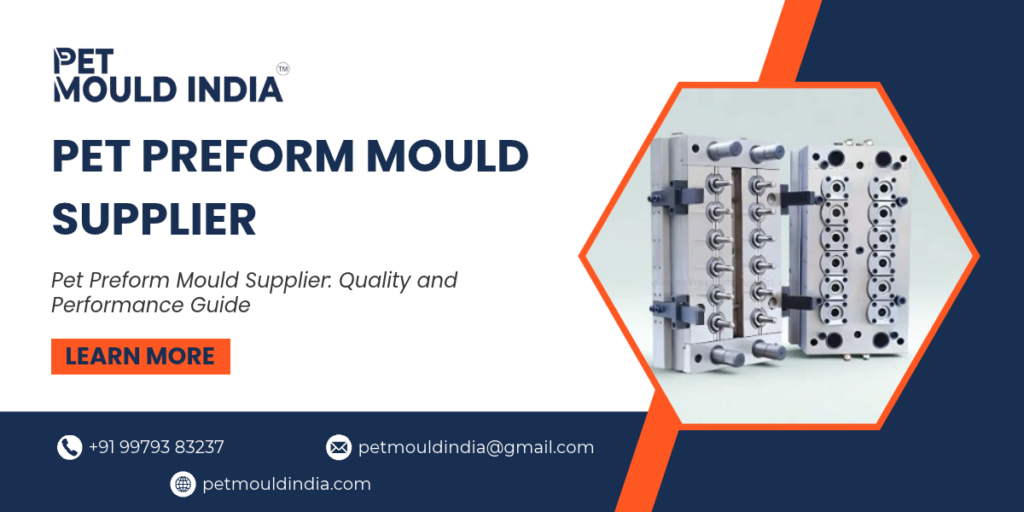
Pet Preform Mould Supplier: Quality and Performance Guide
Selecting the right PET preform mould supplier is essential for businesses involved in PET bottle and packaging manufacturing. A quality mould plays an important role in production consistency, preform accuracy, machine efficiency and long-term operating performance.
A reliable supplier should understand your production requirements and provide mould solutions that match your machine specifications, preform design and expected production capacity. Apart from pricing, manufacturers should evaluate material quality, precision engineering, cavity configuration, cooling systems and technical support.
This guide explains the important factors to consider when choosing a PET preform mould supplier and how the right mould solution can support efficient manufacturing operations.
What Is a PET Preform Mould?
A PET preform mould is an injection mould used to manufacture PET preforms. These preforms are later heated and stretch blow-moulded into finished PET bottles of different shapes and sizes.
The mould determines important preform characteristics such as weight, dimensions, neck finish and overall consistency. Proper mould design and manufacturing accuracy help produce preforms suitable for the required bottle application.
PET preform moulds are widely used in industries such as packaged drinking water, carbonated beverages, food packaging, pharmaceuticals, cosmetics and industrial packaging.
1. Focus on Mould Quality and Material Selection
Mould quality is one of the most important considerations when selecting a PET preform mould supplier. The quality of the material and manufacturing process can influence mould durability, dimensional accuracy and production consistency.
A professional supplier should provide clear information about the materials used and the manufacturing processes followed.
Important quality factors include:
- High-grade mould steel: Supports strength, stability and long-term performance.
- Heat treatment: Helps achieve the required hardness and durability.
- Surface finishing: Supports smooth surfaces and consistent preform quality.
- Corrosion-resistant treatment: Helps protect mould components during use and maintenance.
Always discuss material specifications and quality inspection procedures before confirming your mould order.
2. Check Precision Engineering Capabilities
Precision engineering is essential for manufacturing PET preform moulds with accurate dimensions and consistent cavity performance. Even small variations in mould components can affect the quality of the final preforms.
When comparing suppliers, check their machining equipment and manufacturing capabilities.
Key manufacturing processes may include:
- CNC machining: Helps achieve accurate dimensions and component geometry.
- EDM machining: Supports the production of detailed mould features.
- Surface coating: Helps improve surface properties according to design requirements.
- Heat treatment: Supports the required material hardness.
- Assembly and quality checks: Help verify mould components and overall assembly.
A supplier with suitable precision manufacturing capabilities can develop moulds according to the required technical specifications.
3. Select the Right Cavity Configuration
Cavity configuration directly relates to the production capacity of a PET preform mould. The suitable cavity count depends on the required output, injection machine capacity, preform design and production cycle.
Common configurations include:
- Low-cavity moulds: Suitable for specific production requirements and comparatively lower output volumes.
- Multi-cavity moulds: Produce multiple preforms in a single injection cycle.
- High-cavity moulds: Designed for higher production capacity when supported by the machine and process.
Before choosing a cavity configuration, discuss your target output, machine specifications and production requirements with the supplier.
4. Evaluate the Hot Runner System
The hot runner system is an important part of PET preform mould design. It controls the flow of molten PET material towards the mould cavities during the injection process.
A suitable hot runner configuration helps maintain controlled material distribution and supports consistent filling across the cavities.
When evaluating a supplier, ask about:
- Hot runner system configuration.
- Material flow and temperature control.
- Valve or pneumatic pin arrangements, where applicable.
- Maintenance and replacement requirements.
- Compatibility with your injection moulding machine.
The right system should be selected according to the mould design, PET material requirements and production process.
5. Check Cooling System Design
Cooling is an important factor in PET preform mould performance. A properly designed cooling system helps control mould temperature and supports consistent production cycles.
Cooling performance can influence cycle time, dimensional stability and the quality of the produced preforms.
A reliable PET preform mould supplier should be able to explain the cooling channel design and its suitability for the intended production conditions.
6. Confirm Customisation Options
Different PET bottle manufacturers have different preform requirements. Factors such as bottle capacity, neck finish, preform weight and production machine specifications can vary from one application to another.
Therefore, a supplier offering customised PET preform mould solutions can be valuable for businesses with specific product requirements.
Discuss these details before finalising the mould design:
- Preform weight and dimensions.
- Neck finish and neck size.
- Required cavity configuration.
- Hot runner system requirements.
- Machine make, model and technical specifications.
- Interchangeable components and maintenance needs.
Sharing accurate technical details helps the supplier develop a mould that matches your production requirements.
7. Check Machine Compatibility
Machine compatibility is essential for the proper installation and operation of a PET preform mould. A mould should be designed according to the technical specifications of the injection moulding machine.
Before ordering, provide the supplier with the relevant machine details, including:
- Machine make and model.
- Clamping force.
- Platen dimensions and mould mounting details.
- Injection capacity.
- Cooling and hot runner connections.
A technical compatibility review helps reduce installation problems and supports smoother production operations.
8. Consider Production Performance and Efficiency
A good PET preform mould should support consistent production quality and reliable operation. Production performance depends on several factors, including mould design, machining accuracy, cooling efficiency and machine settings.
When comparing suppliers, evaluate the following performance aspects:
- Consistent preform dimensions and weight.
- Uniform wall thickness as per design requirements.
- Reliable mould operation across production cycles.
- Efficient cooling and material distribution.
- Ease of maintenance and component replacement.
Discuss production expectations with the supplier and confirm which performance characteristics can be supported by the proposed mould design.
9. Evaluate Pricing, Delivery and Technical Support
Price is an important part of supplier selection, but the lowest quotation does not always provide the best long-term value. Mould quality, manufacturing accuracy, delivery commitments and service support should also be considered.
Before placing an order, compare:
- Overall mould design and technical specifications.
- Material quality and manufacturing processes.
- Quotation details and payment terms.
- Manufacturing and delivery timelines.
- Warranty and service conditions.
- Spare parts and maintenance support.
A dependable supplier should provide clear communication throughout the enquiry, design, manufacturing and delivery stages.
Why Choose PET Mould India as Your PET Preform Mould Supplier?
PET Mould India manufactures precision-engineered PET preform moulds designed for accuracy, durability and consistent production performance.
The company highlights advanced CNC machining, high-grade hardened steel, custom engineering and energy-efficient mould solutions. Its listed manufacturing capabilities include CNC machining, EDM precision, surface coating, heat treatment, assembly and quality assurance.
PET Mould India offers PET preform mould configurations with technical specifications that include:
- Cavities: Up to 72.
- Preform weight: 6 g to 760 g.
- Neck size: 12 mm to 150 mm.
- Hot runner: Pneumatic pin system.
- Components: Interchangeable components.
The company also highlights applications across beverage, pharmaceutical, cosmetic, food, dairy, household and industrial packaging sectors.
Actual mould configurations and technical specifications should be confirmed according to your preform design, production requirements and injection machine compatibility.
Explore the PET Preform Mould product page to learn more about the available mould features and manufacturing capabilities.
Checklist for Selecting a PET Preform Mould Supplier
Use the following checklist to evaluate suppliers before making your final decision.
| Selection Factor | What to Evaluate |
|---|---|
| Product Quality | Material grade, durability and finishing |
| Engineering | CNC machining, EDM and precision manufacturing |
| Cavity Configuration | Production capacity and machine suitability |
| Hot Runner System | Configuration and maintenance requirements |
| Cooling System | Cooling design and temperature control |
| Customisation | Preform weight, neck finish and design |
| Machine Compatibility | Machine dimensions and technical specifications |
| Technical Support | Maintenance, spare parts and service |
| Commercial Terms | Pricing, delivery and warranty conditions |
Frequently Asked Questions (FAQs)
1. What should I look for in a PET preform mould supplier?
Look for manufacturing experience, material quality, precision engineering, suitable cavity configurations, customisation options, machine compatibility and dependable technical support.
2. Why is mould quality important in PET preform production?
Mould quality influences dimensional accuracy, preform consistency, production reliability and the long-term performance of the mould.
3. What cavity configurations are available in PET preform moulds?
PET preform moulds are available in different cavity configurations, from low-cavity designs to high-cavity systems. The right option depends on production volume and machine capacity.
4. Can a PET preform mould be customised?
Yes. Moulds can be customised according to preform weight, neck finish, cavity layout, hot runner requirements and machine specifications.
5. What is the role of a hot runner system in PET preform moulds?
A hot runner system controls the flow of molten PET material towards the mould cavities and supports the injection process.
6. Why is after-sales support important when choosing a supplier?
After-sales support helps with mould maintenance, troubleshooting, spare parts and technical assistance, supporting reliable long-term operation.
7. What industries use PET preform moulds?
PET preform moulds are used in beverage, packaged drinking water, food, pharmaceutical, cosmetic, dairy and industrial packaging applications.
Conclusion
Choosing the right PET preform mould supplier is an important step towards achieving consistent product quality and reliable manufacturing performance. Before selecting a supplier, evaluate mould material, precision engineering, cavity configuration, hot runner technology, cooling design, customisation and machine compatibility.
A supplier that understands your technical and production requirements can help you select a suitable mould solution for your business. Consider long-term performance, maintenance and technical support along with the initial investment.
Looking for precision-engineered PET preform mould solutions? Contact PET Mould India to discuss your requirements and explore suitable mould options.
 Users Today : 1
 Users This Month : 4
 Total Users : 5